
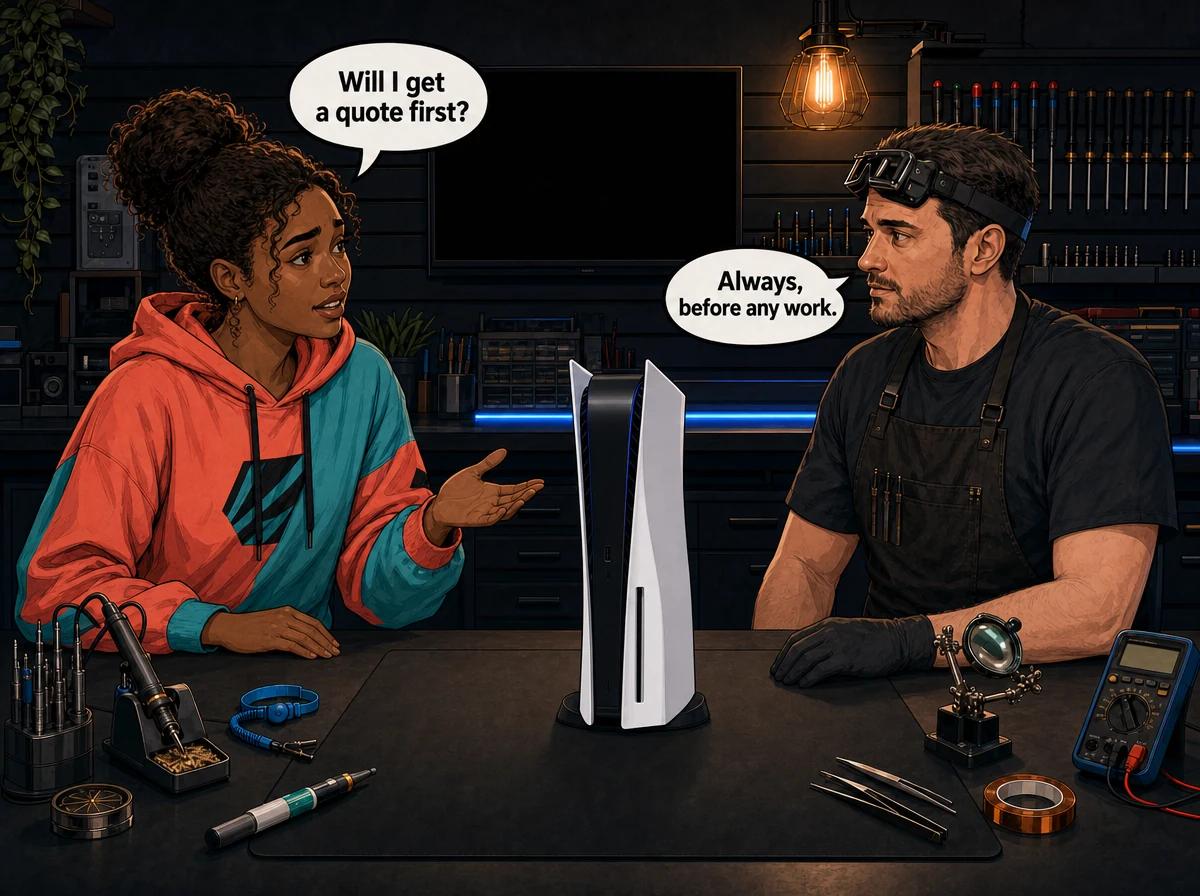
Your console has stopped working, you have found a repair shop, and now there is a small knot of anxiety about the actual handover. What do you say? Will they laugh at you for not knowing the technical terms? Will they start work and hand you a bill you never agreed to? What if they open it up and tell you it cannot be saved — do you pay for nothing?
Those are the questions almost every customer asks in their first message, and they are fair questions. You are handing over an expensive piece of electronics to a stranger. This is the honest, step-by-step version of what to tell a repair shop and what should happen next, written from the side of the bench that actually does the work.
The console repair process in South Africa is not a mystery, and a good shop makes it feel simple. You describe the symptom in plain words, the shop diagnoses the real fault, you get a written quote before anyone touches a screwdriver, and you decide. Nothing about that should catch you off guard, and if a shop skips the quote step or cannot explain what it found, that tells you something too.
The Short Version: What to Say and What to Expect
Tell the shop three things: what the console is doing wrong, when it started, and anything unusual that happened just before. That is enough. You do not need part numbers or error-code knowledge — describing the symptom in everyday language is exactly what a technician wants to hear.
From there, a proper shop diagnoses the fault before quoting. You should get a written quote that names the actual repair and its price, and you should be free to say no. If you decline or the console turns out to be beyond economical repair, a fair shop charges only a small bench fee for the diagnostic time, not the full repair. If you go ahead, that fee falls away. Everything that comes back should be tested and carry a warranty.
That is the whole shape of it. The rest of this post fills in each step so nothing surprises you.
What to Tell the Shop (The Description That Actually Helps)
The single most useful thing you can do is describe the symptom clearly. Not the diagnosis — the symptom. Leave the "it's probably the HDMI chip" guessing to the person with the microscope. Your job is to describe what you see and hear.
Good descriptions sound like this:
- "It powers on, the fan spins, but there is no picture on the TV — the TV just says no signal."
- "It turns on for a few seconds, then shuts itself off, and the light flashes before it dies."
- "It reads digital games fine but grinds and spits out every disc I put in."
- "It freezes on the home screen after about ten minutes, every time, then the picture stutters."
- "I heard three beeps and it went dead."
Every one of those points a technician straight at a category of fault. Notice that none of them use a single technical term. "No picture but the console is clearly on" is worth more to us than "I think the GPU is gone", because the symptom is a fact and the guess is often wrong.
The details that genuinely help
Beyond the main symptom, a few extras speed up the diagnosis and can change the outcome:
- When it started. Suddenly, or getting worse over weeks? A fault that appeared overnight and one that crept in point to different causes.
- What happened just before. A drop, a move, a spilled drink, a power surge during load shedding, a lightning storm, or a failed DIY attempt. This is the most important detail and the one people most often leave out, usually out of embarrassment. Say it anyway.
- What you have already tried. Different HDMI cable, different TV, different plug, safe mode, a rebuild of the database. If you have ruled things out, we do not have to repeat them.
- Whether it still does it every time, or only sometimes. Intermittent faults are real and we chase them, but knowing it is intermittent up front saves a lot of confused testing.
You do not have to volunteer any of this in a formal way. On WhatsApp, a couple of sentences does the job. The clearer the picture you paint, the faster and cheaper the diagnosis tends to be.
What You Do Not Need to Worry About Saying
Plenty of customers over-prepare, or worse, stay quiet because they think they will sound stupid. Let this go.
You do not need to know the model number off by heart — we can read it off the console. You do not need to know whether it is the board, the power supply or the HDMI port — that is literally what the diagnosis is for. You do not need to use the right words for anything. "The picture bit is broken" is a perfectly good starting point.
And you never need to hide a DIY attempt. We would far rather you told us that you opened it and something went wrong, because it changes where we look first. A console that was opened and now has a torn ribbon cable is a different job to one that simply died on its own, and pretending otherwise only slows us down. There is no judgement on our bench — we see it every week.
The one thing worth being honest about is history. If the console has been repaired before, tell us. If it got wet a year ago and "dried out fine", tell us. Old damage has a way of coming back, and knowing about it saves guesswork.
How Diagnosis Works Once the Console Arrives
Here is what happens after you hand it over or the courier drops it off, so the wait does not feel like a black box.
The console is booked in against your name and contact number, and your description of the fault goes on the job with it. A technician then reproduces the symptom — powers it up, watches what you described actually happen, and confirms it rather than taking the report at face value. A console that "won't turn on" sometimes turns on fine for us, which itself is a clue.
From there the diagnosis narrows the fault to a specific cause. Sometimes that is quick and obvious. Sometimes a "no picture" fault could be the port, the encoder chip behind it, or a board fault further back, and separating those takes proper testing under magnification. The point of this stage is to find the real cause, not the first plausible one, because quoting you for the wrong repair helps nobody.
Only once the actual fault is known does the shop work out the repair and the price. That order matters. Any shop that quotes you a firm price over the phone from a one-line description is guessing, and a guess can swing by thousands of rand once the console is actually open.
The Quote: Will I Get One, and What Is In It?
Yes, you should always get a quote, and you should get it before any repair work begins. This is the part customers worry about most, and it is the part a good shop makes non-negotiable.
A proper quote names the specific repair, not just a number. "HDMI port replacement" or "full service and liquid metal reapplication" tells you what you are paying for. It states the price to be paid — the figure you are quoted is the full amount, with nothing extra added on the paperwork. And it should come to you in writing, on WhatsApp or email, so there is a record you both agreed to.
You are free to say no. That is the whole point of quoting before working. If the repair costs more than the console is worth to you, you can decline and take back your console. We have written a separate guide on whether a repair is worth it that walks through the maths of repair versus replacement, because it is a genuine decision and not always an obvious one.
What a quote should never be is a moving target. The price you approve is the price you pay. If a shop opens your console, finds a second unrelated fault and wants to add to the bill, that is a fresh quote and a fresh decision for you to make — not a surprise on the final invoice.
What Happens If It Cannot Be Fixed
This is the fear underneath all the others: I send it in, they can't fix it, and I have paid for nothing. Here is how a fair shop handles it.
If the console is beyond economical repair — the motherboard is cracked, a fault is chasing another fault, or the parts and labour would cost more than a replacement — you are told plainly, before any charge for repair work. What you do pay is a bench fee for the diagnostic time and expertise it took to reach that answer.
At Console Service Centre that bench fee is R599. It covers the diagnosis, not a repair. It applies in exactly two situations: you decline the repair after we have quoted, or the console cannot be economically saved. If you go ahead with the repair, the R599 falls away — it is not added on top. And we never charge it on a warranty return, because a fault that comes back inside the warranty window is on us, not you.
That is the "no-fix, no-fee" idea people mean, stated properly: you are not billed for a repair that did not happen. You are charged a fair, capped amount for the work of finding out, and only when you either walk away or there is genuinely nothing to be done. A shop that wants full payment for a repair it could not complete is not one to use again.
What Repairs Typically Cost
Prices depend on the exact fault and the exact console, which is why the real number comes from the diagnosis. But it helps to walk in with a sense of scale, so here are the common PS5 jobs as an example — the same fault on a PS4 or Xbox lands in a similar range, and your quote is always specific to your console.
A full service, which is a complete strip-down, clean, and thermal replacement, is R1,249. An HDMI port replacement, the fix for the classic "console on, no picture" fault caused by a damaged port, is R1,299. A disc drive replacement, for a drive that no longer reads or accepts discs, is R2,199 – R2,299. A power supply replacement runs R1,749 – R4,199, depending on which unit revision your console uses.
Those figures come straight from our live pricing, so they are current as you read this. They are also why an honest shop diagnoses before quoting — the difference between a port that needs a clean and a board fault behind it is the difference between a modest repair and a major one, and only opening the console tells you which you are looking at.
Not sure what your fault is likely to cost? WhatsApp us on 087 550 2307 — we respond immediately, 24/7, and from a good description of the symptoms we can usually give you a ballpark before you send anything in.
How Long Will It Take?
Turnaround is the other big question, and the honest answer is that it depends on two things: what the fault turns out to be, and where you are in the bench queue when it arrives. A clean full service moves faster than a board-level repair that needs a part ordered.
For that reason we give you a realistic timeframe on WhatsApp when you book, once we know the symptom, rather than promising a fixed number on a web page that cannot see your console. What we will not do is start a clock we cannot honour. If a part has to come in, we tell you. If the diagnosis reveals a bigger job than the symptom suggested, we tell you that too, with a fresh quote, before the timeline changes.
If you are outside Gauteng and using the courier, add a day or two on each side for transit. That is the courier's time, not the repair time, and it is worth factoring in when you are planning around being without your console.
Sending It In by Courier: What to Expect
If you cannot get to the workshop, most of this process happens exactly the same way by nationwide courier collection — the diagnosis, the quote, the decision and the warranty are identical whether you walk in or ship in.
The practical differences are worth knowing up front. Pack the console properly: the original box if you have it, otherwise a sturdy box with real padding around all six sides, because couriers are not gentle. Send only the console and its power cable unless we ask for more — leave everything else at home, and sending less means less to lose or damage in transit. Note down anything you are including so it can be checked back to you on return.
We book the collection, you hand the parcel over, and the fault description you gave on WhatsApp travels with the job. From there it is the same flow: diagnose, quote, your decision, repair, test, and return. We keep you updated at each step rather than leaving you wondering where your console is.
Insurance and Damage-Report Jobs
Not every job is a straight repair. If your console was damaged by a power surge, lightning, theft-related impact or an accident, your household insurance may cover it, and the shop's role changes slightly.
For an insurance claim you usually need a damage report or assessment that states what failed and what it would cost to repair or replace. We produce that as an insurance damage report — a formal document your insurer can work from. What to expect here is a little more paperwork and a little less urgency, because the claim runs on the insurer's timeline, not ours.
One thing worth knowing going in: most policies carry an excess — a set amount you pay regardless of the claim outcome — and it varies from policy to policy, so check yours before you commit. Whether it is worth claiming at all depends on your excess versus the repair cost — sometimes a straightforward repair is cheaper than the excess, and we will say so rather than push you toward a claim you do not need.
What You Get Back
The console that comes back to you should be more than "not broken". A proper repair ends with testing, not with reassembly. We power the console up, put the original fault through its paces to confirm it is genuinely resolved, and check that nothing else was disturbed in the process. We do not hand back a console we have not watched run.
Every repair carries a six-month money-back warranty. If the same fault returns inside that window, we fix it again at no charge — no bench fee, no argument. That warranty is the real test of whether a shop stands behind its work, and it is why the testing step matters: we would rather find a marginal repair on our own bench than have it come back to yours.
You also get back a console that has been handled by people who only work on consoles. 1,346+ Google reviews at 4.9 stars — the world's most-reviewed dedicated gaming-console repair specialist on Google — that track record exists because the boring parts, the testing and the warranty and the honest quote, are done properly every time.
Your Games and Saves
A question that quietly worries a lot of people: will a repair wipe my games and saves? For the vast majority of repairs, no. A port replacement, a full service, a fan or power supply job, a disc drive swap — none of those touch the storage where your games and saved data live, so your library comes back exactly as it was.
The exception is a storage fault itself. If the console's drive has failed, the repair by definition involves that drive, and data on a failed drive may not be recoverable — that is the nature of a dead drive, not a choice the shop makes. This is the best argument there is for cloud-syncing your saves while the console is healthy, so that a hardware failure never costs you your progress as well.
If keeping your data matters and you are unsure whether the fault touches it, say so when you book. We will tell you honestly whether the repair puts anything at risk before you commit.
Why We Ask You Not to Open It First
It is tempting, when a console dies, to have a go yourself before paying anyone. A quick warning, then, from the people who fix the results.
The most expensive repairs that arrive on our bench are not the ones that broke on their own — they are the ones a customer opened first. The PS5's fan connector tears off the board easily, taking its traces with it, and rebuilding those is hours of micro-soldering that dwarfs the original job. Stripped screws, torn flex cables and cracked clips all turn a simple repair into a complicated one. Worst of all, a console power supply holds a charge capable of a serious shock long after it is unplugged, which is why we will never walk anyone through opening one.
Opening your console yourself risks causing additional damage — broken flex cables, stripped screws, or damaged connectors that make the repair more expensive. Cleaning the outside and clearing the vents from the outside is safe and worth doing. Everything past the covers is best left to someone who does it daily. If the diagnosis turns out to be a serious internal fault, that becomes a board-level repair assessment, and we will tell you honestly whether it is economical before we touch it.
The Process in One Line
Describe the symptom in plain words. The shop diagnoses the real fault. You get a written quote before any work. You decide. If it goes ahead, it is repaired, tested and returned under warranty. If it does not, you pay only the capped bench fee for the diagnosis. That is what a fair console repair looks like from start to finish — no jargon required from you, and no surprises on the invoice.
Frequently Asked Questions
What do I need to tell a repair shop about my console?
Describe what it is doing wrong, when the problem started, and anything unusual that happened just before — a drop, a spill, a power surge, or a DIY attempt. You do not need technical terms or part numbers. A clear symptom in everyday language ("it turns on but there is no picture") is exactly what a technician needs to point the diagnosis in the right direction.
Will I get a quote before any repair work starts?
Yes. A proper shop diagnoses the fault first, then sends you a written quote naming the specific repair and its price before touching anything. You are free to decline. The price you approve is the price you pay — a second, unrelated fault found later is a fresh quote and a fresh decision, never a surprise added to the final bill.
What happens if my console cannot be fixed?
You are told plainly before any repair charge, and you pay only the R599 bench fee, which covers the diagnostic time rather than a repair. That fee also applies if you decline the repair after a quote. If you go ahead with the repair instead, the R599 falls away, and it is never charged on a warranty return.
How long does a console repair take in South Africa?
It depends on the fault and the bench queue, so we give you a realistic timeframe on WhatsApp once we know the symptom, rather than a fixed number that cannot account for your specific console. A full service moves faster than a board repair that needs a part ordered. If you use the nationwide courier, add a day or two each way for transit.
Will a repair delete my games or saved data?
For most repairs, no. HDMI, power supply, disc drive, fan and full-service jobs do not touch the storage where your games and saves live, so they come back untouched. The exception is a failed storage drive, where data may not be recoverable because the drive itself is the fault. Cloud-syncing your saves while the console is healthy is the safest protection.
Do you repair all PlayStation and Xbox consoles?
We repair the PS4, PS5, Xbox One and Xbox Series families — every model in each. You can see the full breakdown of what we do on our console repair services pages, including a dedicated PS5 repair page. If you are not sure which model you own, we can identify it from the console when it arrives.
Ready to Book Your Console In?
You now know exactly what to say and exactly what should happen next. Describe the symptom, get a quote, decide — no jargon, no pressure, no surprises.
Here's why Console Service Centre is the right place for it:
- PlayStation and Xbox specialists — consoles are all we do, so the diagnosis is done by people who see your fault every week
- A written quote before any work, with no hidden extras
- A capped R599 bench fee only if you decline or the console cannot be saved — never on top of a repair you approve
- Six-month money-back warranty on every repair
- Nationwide courier collection and return, with the same process whether you walk in or ship in
WhatsApp us: 087 550 2307 — we respond immediately, 24/7
Visit us: 6 Bester Street, Witfield, Boksburg — Monday to Thursday 08:00 to 16:00, Friday and Saturday 08:00 to 13:00
Not in Gauteng? We collect and return nationwide by courier. Book it on WhatsApp, we send the waybill, you hand it over — and the quote, the decision and the warranty work exactly the same way.
Topics Covered
About the Author

Shaun Potgieter
Founder & Head Technician
Expert console technician with 15+ years of hands-on repair experience.